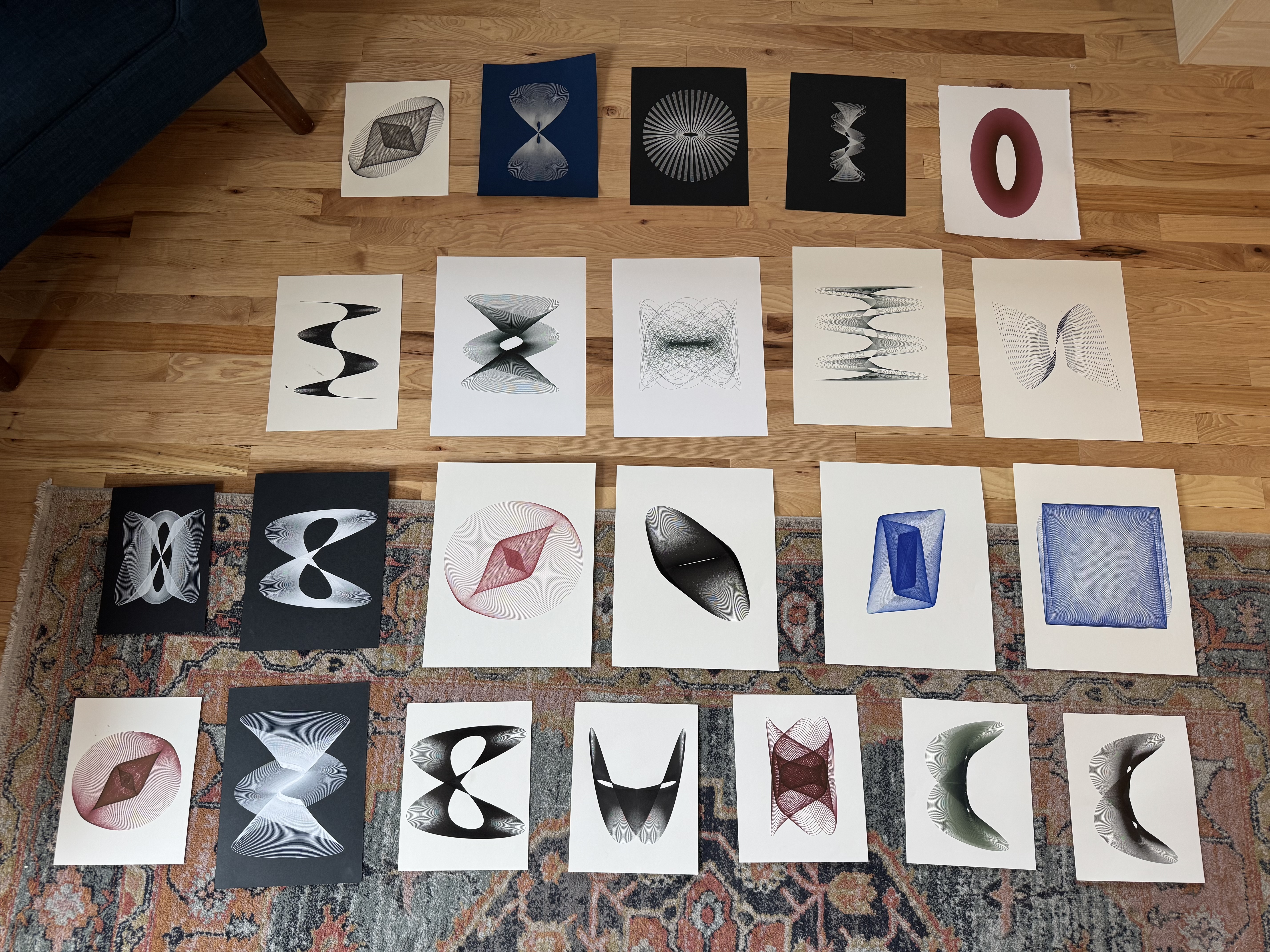
FROM SYSTEM TO SURFACE
Pendulums were built as generative systems, but from the beginning, they behaved like drawings.
Each piece is generated as a continuous trace, a line revealing the motion and decay of a system over time. Whether solid or broken, every output exists as a path, something that reads less like an image and more like something drawn.
Because of that, bringing these works into the physical world was never a question of if, but when.
What started as a digital system was always meant to return to paper.
FROM CODE TO MATERIAL
Translating that system into a physical process introduced an entirely new layer of complexity.
The machine itself is precise. The challenge is everything surrounding it.
The same line that exists perfectly in code has to move through ink, paper, pressure, and surface. What appears clean digitally can tear through paper, pool unevenly, or break down under repeated passes in dense areas.
I approached this without knowing what the demand would be. The goal was simply to see if the physical result could hold up to what I was seeing on screen.
That process quickly turned into its own rabbit hole.
WHEN THE LINE MEETS MATERIAL
The variables multiply fast.
Ink type, pigment density, flow, delivery mechanism, paper surface, absorbency, friction. Small changes in any one of these can completely alter the result.
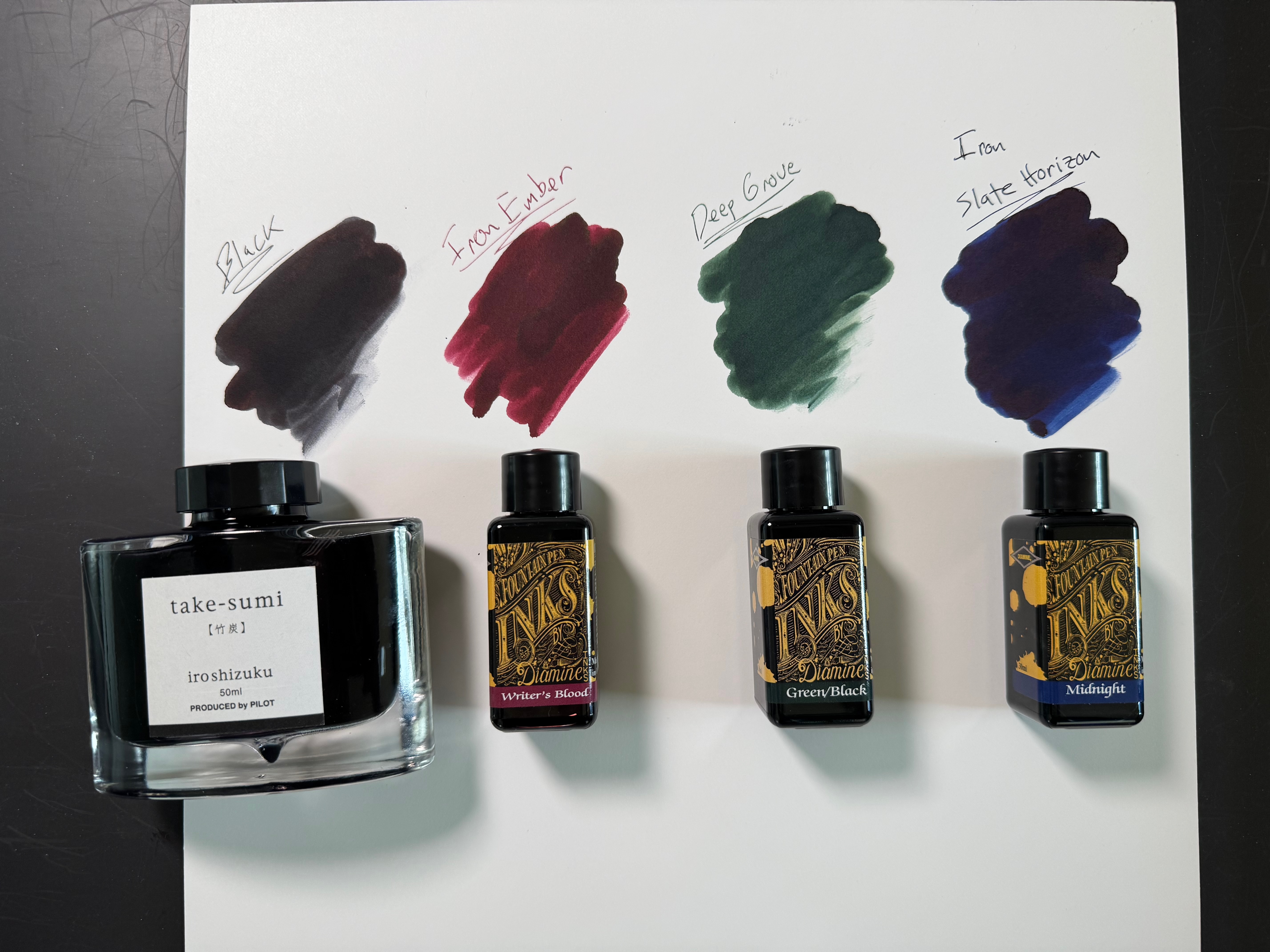
After extensive testing across dozens of papers and hundreds of pens and pen types, the process began to separate into two distinct approaches.
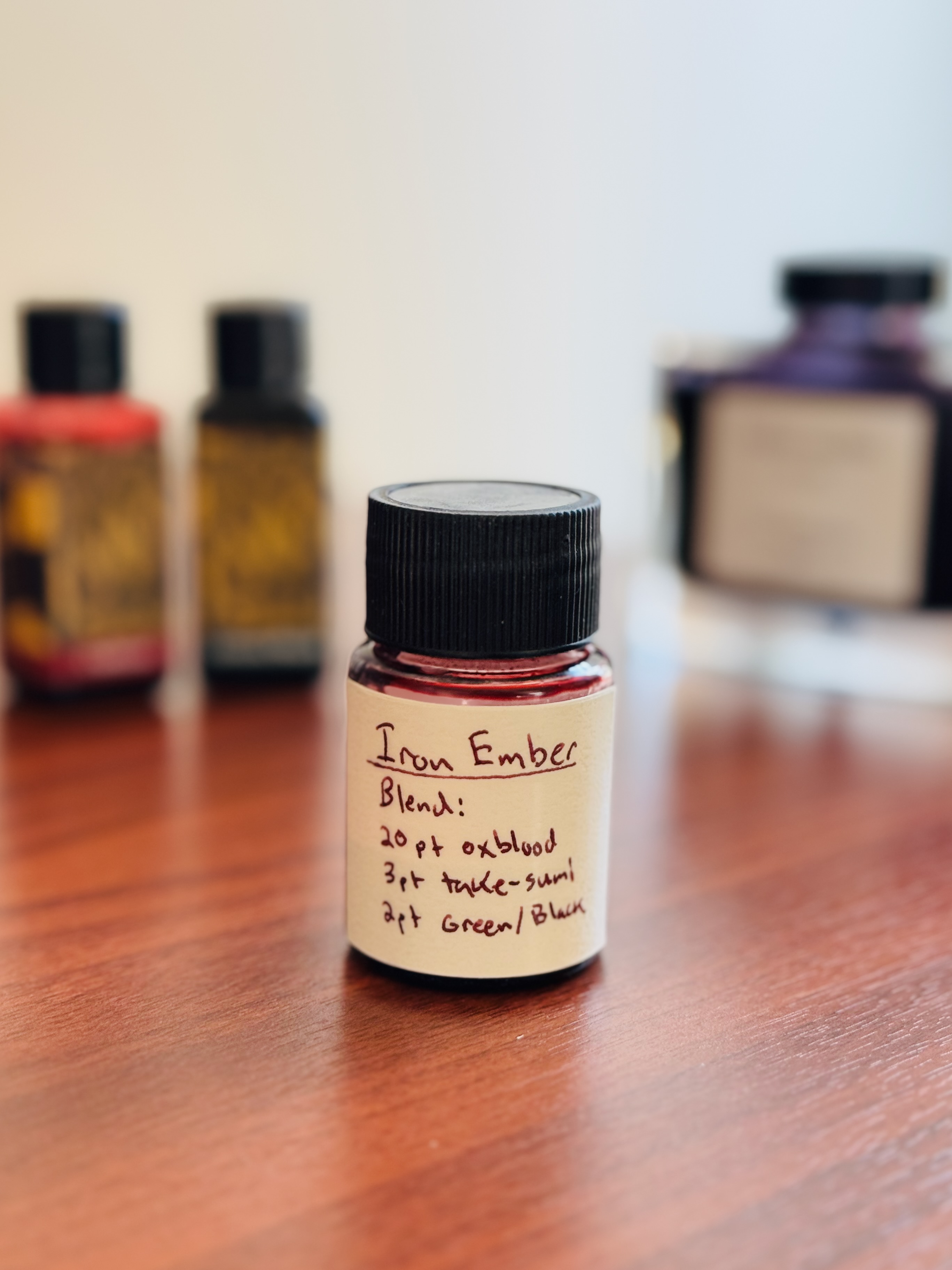
For light mode works, fountain pens and dye-based inks became the foundation. The ink absorbs into the paper, producing a clean, archival line that closely reflects the intended structure of the system.
For denser systems, where lines overlap repeatedly, rollerball pens modified to use fountain inks are used to carry the same color while reducing friction and preserving the surface of the paper.
WHERE PRECISION BREAKS DOWN
Dark mode works behave entirely differently.
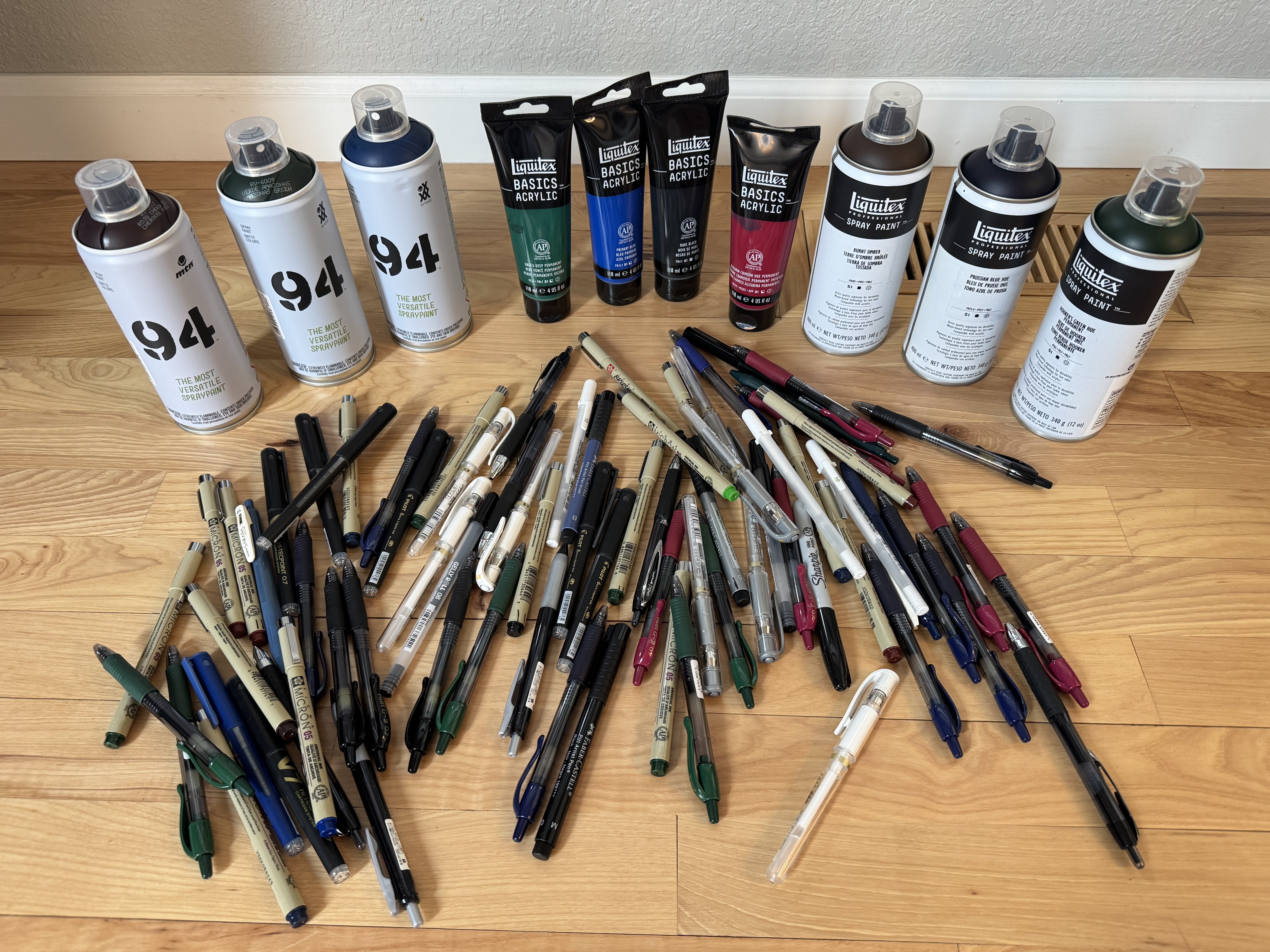
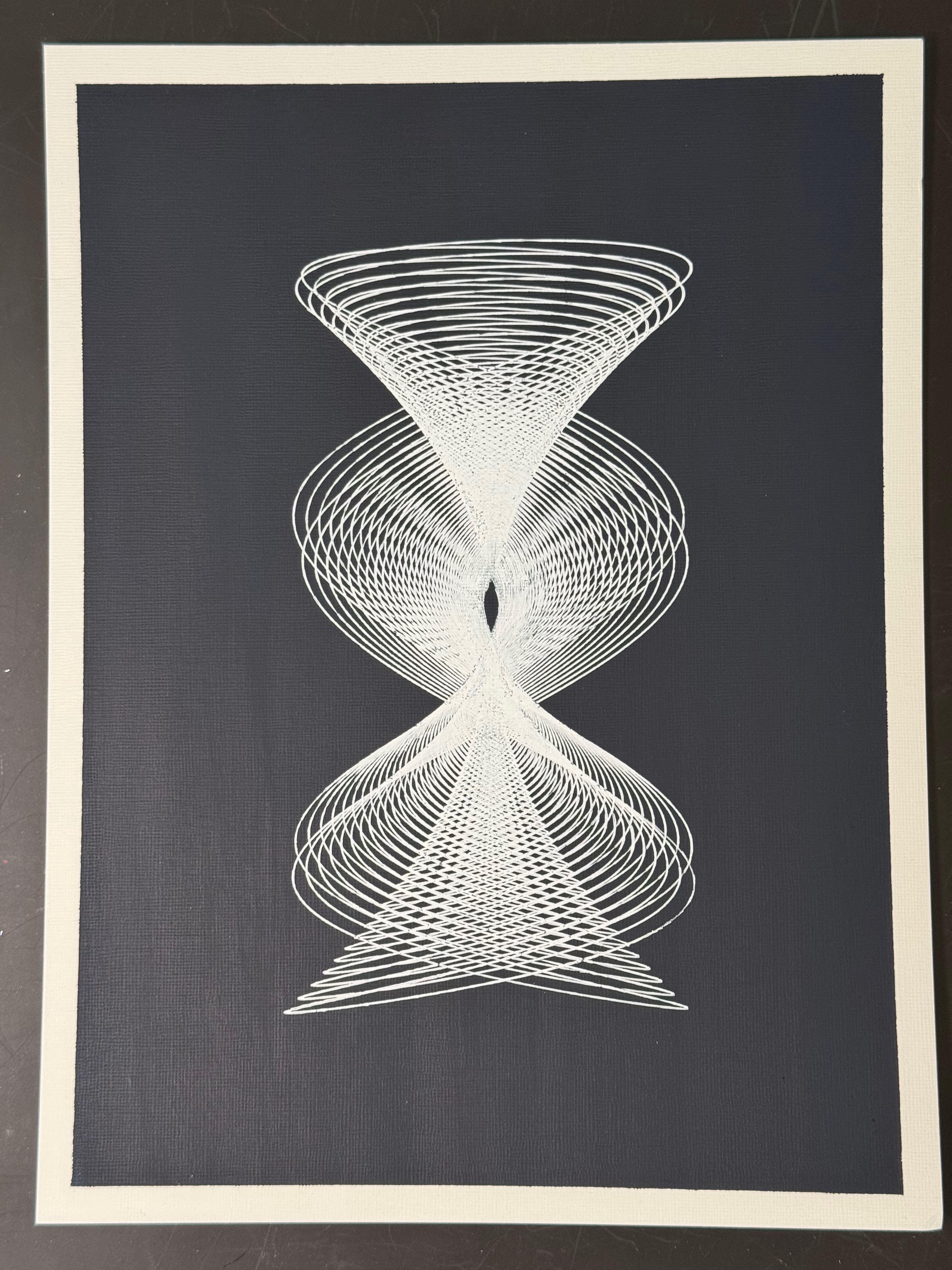
White and metallic inks are heavier, more opaque, and sit on top of the paper rather than absorbing into it. In dense regions, they can build up, scrape, or break down under repeated passes. Instead of a clean line, they begin to introduce texture.
Rather than forcing them to behave like light mode plots, the process leans into this difference.
For color-based dark mode works, the paper itself is painted first using archival pigments, creating a base layer before the system is drawn on top. These pieces move closer to painting, where the plotted line interacts with a prepared surface rather than a blank one.
Each piece requires decisions based on the behavior of the system it represents.
NO TWO ARE THE SAME
Every plot is made individually.
Even when the same system is used, the result will never be identical. Line weight shifts slightly. Ink distributes differently. Small variations emerge through the interaction between pen and surface.
These are not errors. They are the point where the system meets the physical world.
Each piece becomes a record not just of the pendulum, but of the process used to bring it into form.
ON-CHAIN RECORD
Each work is signed, dated, and editioned, and is accompanied by an on-chain Certificate of Authenticity using the TRACE protocol by Transient Labs.
The certificate stores details behind the piece, including process documentation, materials, and supporting media, linking the physical object back to its origin in the system.
BACK TO PAPER
What began as a digital exploration of motion returns here as something tangible.
A system defined by precision, translated through a process defined by material.